 Add to Chrome
 Add to Firefox
 Add to Edge
Knowledge-Driven 3D Semantic Spectrum Map: KE-VQ-Transformer Based UAV Semantic Communication and Map Completion
Dec 24, 2025


Artificial intelligence (AI)-native three-dimensional (3D) spectrum maps are crucial in spectrum monitoring for intelligent communication networks. However, it is challenging to obtain and transmit 3D spectrum maps in a spectrum-efficient, computation-efficient, and AI-driven manner, especially under complex communication environments and sparse sampling data. In this paper, we consider practical air-to-ground semantic communications for spectrum map completion, where the unmanned aerial vehicle (UAV) measures the spectrum at spatial points and extracts the spectrum semantics, which are then utilized to complete spectrum maps at the ground device. Since statistical machine learning can easily be misled by superficial data correlations with the lack of interpretability, we propose a novel knowledge-enhanced semantic spectrum map completion framework with two expert knowledge-driven constraints from physical signal propagation models. This framework can capture the real-world physics and avoid getting stuck in the mindset of superficial data distributions. Furthermore, a knowledge-enhanced vector-quantized Transformer (KE-VQ-Transformer) based multi-scale low-complex intelligent completion approach is proposed, where the sparse window is applied to avoid ultra-large 3D attention computation, and the multi-scale design improves the completion performance. The knowledge-enhanced mean square error (KMSE) and root KMSE (RKMSE) are introduced as novel metrics for semantic spectrum map completion that jointly consider the numerical precision and physical consistency with the signal propagation model, based on which a joint offline and online training method is developed with supervised and unsupervised knowledge loss. The simulation demonstrates that our proposed scheme outperforms the state-of-the-art benchmark schemes in terms of RKMSE.

Sensing-enabled Secure Rotatable Array System Enhanced by Multi-Layer Transmitting RIS
Nov 17, 2025Programmable metasurfaces and adjustable antennas are promising technologies. The security of a rotatable array system is investigated in this paper. A dual-base-station (BS) architecture is adopted, in which the BSs collaboratively perform integrated sensing of the eavesdropper (the target) and communication tasks. To address the security challenge when the sensing target is located on the main communication link, the problem of maximizing the secrecy rate (SR) under sensing signal-to-interference-plus-noise ratio requirements and discrete constraints is formulated. This problem involves the joint optimization of the array pose, the antenna distribution on the array surface, the multi-layer transmitting RIS phase matrices, and the beamforming matrices, which is non-convex. To solve this challenge, an two-stage online algorithm based on the generalized Rayleigh quotient and an offline algorithm based on the Multi-Agent Deep Deterministic Policy Gradient are proposed. Simulation results validate the effectiveness of the proposed algorithms. Compared to conventional schemes without array pose adjustment, the proposed approach achieves approximately 22\% improvement in SR. Furthermore, array rotation provides higher performance gains than position changes.
RaLD: Generating High-Resolution 3D Radar Point Clouds with Latent Diffusion
Nov 10, 2025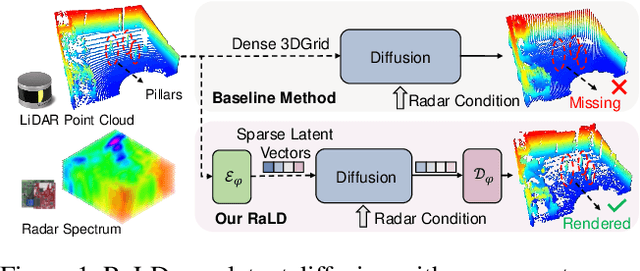
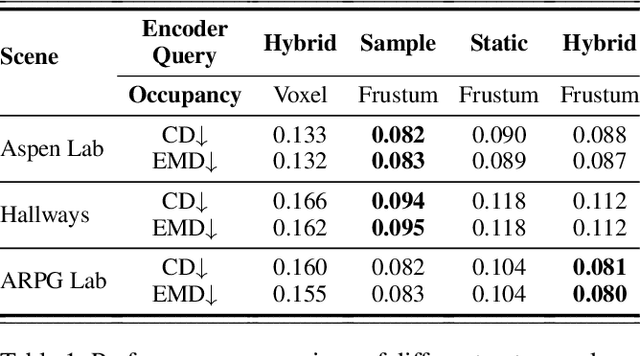

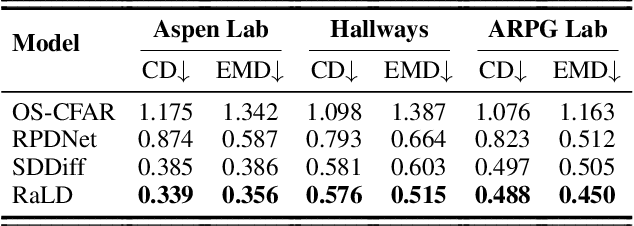
Millimeter-wave radar offers a promising sensing modality for autonomous systems thanks to its robustness in adverse conditions and low cost. However, its utility is significantly limited by the sparsity and low resolution of radar point clouds, which poses challenges for tasks requiring dense and accurate 3D perception. Despite that recent efforts have shown great potential by exploring generative approaches to address this issue, they often rely on dense voxel representations that are inefficient and struggle to preserve structural detail. To fill this gap, we make the key observation that latent diffusion models (LDMs), though successful in other modalities, have not been effectively leveraged for radar-based 3D generation due to a lack of compatible representations and conditioning strategies. We introduce RaLD, a framework that bridges this gap by integrating scene-level frustum-based LiDAR autoencoding, order-invariant latent representations, and direct radar spectrum conditioning. These insights lead to a more compact and expressive generation process. Experiments show that RaLD produces dense and accurate 3D point clouds from raw radar spectrums, offering a promising solution for robust perception in challenging environments.
Explainable Deep Learning Based Adversarial Defense for Automatic Modulation Classification
Sep 19, 2025Deep learning (DL) has been widely applied to enhance automatic modulation classification (AMC). However, the elaborate AMC neural networks are susceptible to various adversarial attacks, which are challenging to handle due to the generalization capability and computational cost. In this article, an explainable DL based defense scheme, called SHapley Additive exPlanation enhanced Adversarial Fine-Tuning (SHAP-AFT), is developed in the perspective of disclosing the attacking impact on the AMC network. By introducing the concept of cognitive negative information, the motivation of using SHAP for defense is theoretically analyzed first. The proposed scheme includes three stages, i.e., the attack detection, the information importance evaluation, and the AFT. The first stage indicates the existence of the attack. The second stage evaluates contributions of the received data and removes those data positions using negative Shapley values corresponding to the dominating negative information caused by the attack. Then the AMC network is fine-tuned based on adversarial adaptation samples using the refined received data pattern. Simulation results show the effectiveness of the Shapley value as the key indicator as well as the superior defense performance of the proposed SHAP-AFT scheme in face of different attack types and intensities.
Distributed Multi-Task Learning for Joint Wireless Signal Enhancement and Recognition
Sep 19, 2025Wireless signal recognition (WSR) is crucial in modern and future wireless communication networks since it aims to identify the properties of the received signal in a no-collaborative manner. However, it is challenging to accurately classify signals in low signal-to-noise ratio (SNR) conditions and distributed network settings. In this paper, we propose a novel distributed multi-task learning framework for joint wireless signal enhancement and recognition (WSER), addressing the crucial need for non-collaborative signal identification in modern wireless networks. Our approach integrates a wireless signal enhancement and recognition network (WSERNet) with FedProx+, an enhanced federated learning algorithm designed for heterogeneous data distributions. Specifically, WSERNet leverages an asymmetric convolution block (ACBlock) to capture long-range dependencies in the input signal and improve the performance of the deep learning model. FedProx+ introduces a proximal term to the loss function to encourage the model updates to be closer to the previous model, enhancing the convergence speed and robustness of federated learning. Extensive experiments demonstrate the effectiveness of the proposed framework for joint WSER, achieving superior performance compared to state-of-the-art methods under both centralized and distributed settings including independent and identically distributed (IID) and non-IID data distributions.
* accepted by Transactions on Cognitive Communications and Networking
Joint Resource Optimization Over Licensed and Unlicensed Spectrum in Spectrum Sharing UAV Networks Against Jamming Attacks
Jul 23, 2025Unmanned aerial vehicle (UAV) communication is of crucial importance in realizing heterogeneous practical wireless application scenarios. However, the densely populated users and diverse services with high data rate demands has triggered an increasing scarcity of UAV spectrum utilization. To tackle this problem, it is promising to incorporate the underutilized unlicensed spectrum with the licensed spectrum to boost network capacity. However, the openness of unlicensed spectrum makes UAVs susceptible to security threats from potential jammers. Therefore, a spectrum sharing UAV network coexisting with licensed cellular network and unlicensed Wi-Fi network is considered with the anti-jamming technique in this paper. The sum rate maximization of the secondary network is studied by jointly optimizing the transmit power, subchannel allocation, and UAV trajectory. We first decompose the challenging non-convex problem into two subproblems, 1) the joint power and subchannel allocation and 2) UAV trajectory design subproblems. A low-complexity iterative algorithm is proposed in a alternating optimization manner over these two subproblems to solve the formulated problem. Specifically, the Lagrange dual decomposition is exploited to jointly optimize the transmit power and subchannel allocation iteratively. Then, an efficient iterative algorithm capitalizing on successive convex approximation is designed to get a suboptimal solution for UAV trajectory. Simulation results demonstrate that our proposed algorithm can significantly improve the sum transmission rate compared with the benchmark schemes.
Knowledge Graph-Based Explainable and Generalized Zero-Shot Semantic Communications
Jul 03, 2025Data-driven semantic communication is based on superficial statistical patterns, thereby lacking interpretability and generalization, especially for applications with the presence of unseen data. To address these challenges, we propose a novel knowledge graph-enhanced zero-shot semantic communication (KGZS-SC) network. Guided by the structured semantic information from a knowledge graph-based semantic knowledge base (KG-SKB), our scheme provides generalized semantic representations and enables reasoning for unseen cases. Specifically, the KG-SKB aligns the semantic features in a shared category semantics embedding space and enhances the generalization ability of the transmitter through aligned semantic features, thus reducing communication overhead by selectively transmitting compact visual semantics. At the receiver, zero-shot learning (ZSL) is leveraged to enable direct classification for unseen cases without the demand for retraining or additional computational overhead, thereby enhancing the adaptability and efficiency of the classification process in dynamic or resource-constrained environments. The simulation results conducted on the APY datasets show that the proposed KGZS-SC network exhibits robust generalization and significantly outperforms existing SC frameworks in classifying unseen categories across a range of SNR levels.
Revolution of Wireless Signal Recognition for 6G: Recent Advances, Challenges and Future Directions
Mar 11, 2025Wireless signal recognition (WSR) is a crucial technique for intelligent communications and spectrum sharing in the next six-generation (6G) wireless communication networks. It can be utilized to enhance network performance and efficiency, improve quality of service (QoS), and improve network security and reliability. Additionally, WSR can be applied for military applications such as signal interception, signal race, and signal abduction. In the past decades, great efforts have been made for the research of WSR. Earlier works mainly focus on model-based methods, including likelihood-based (LB) and feature-based (FB) methods, which have taken the leading position for many years. With the emergence of artificial intelligence (AI), intelligent methods including machine learning-based (ML-based) and deep learning-based (DL-based) methods have been developed to extract the features of the received signals and perform the classification. In this work, we provide a comprehensive review of WSR from the view of applications, main tasks, recent advances, datasets and evaluation metrics, challenges, and future directions. Specifically, intelligent WSR methods are introduced from the perspective of model, data, learning and implementation. Moreover, we analyze the challenges for WSR from the view of complex, dynamic, and open 6G wireless environments and discuss the future directions for WSR. This survey is expected to provide a comprehensive overview of the state-of-the-art WSR techniques and inspire new research directions for WSR in 6G networks.
UAV Cognitive Semantic Communications Enabled by Knowledge Graph for Robust Object Detection
Feb 06, 2025
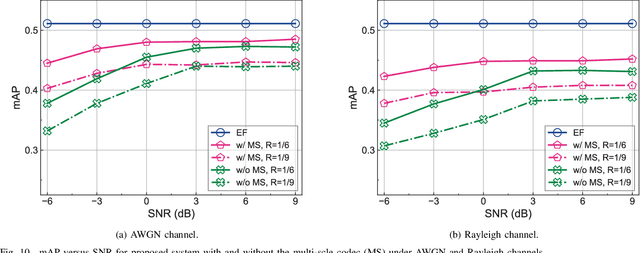
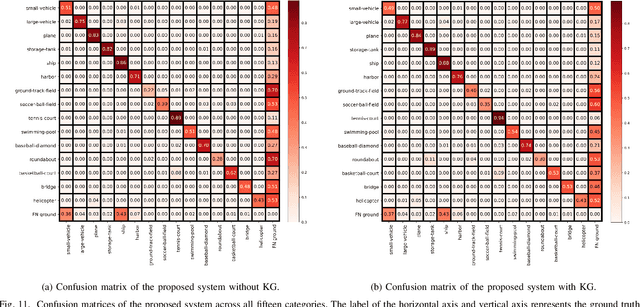
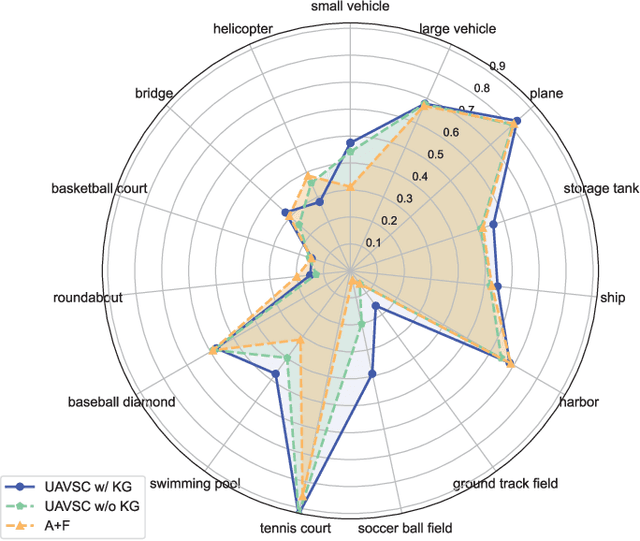
Unmanned aerial vehicles (UAVs) are widely used for object detection. However, the existing UAV-based object detection systems are subject to severe challenges, namely, their limited computation, energy and communication resources, which limits the achievable detection performance. To overcome these challenges, a UAV cognitive semantic communication system is proposed by exploiting a knowledge graph. Moreover, we design a multi-scale codec for semantic compression to reduce data transmission volume while guaranteeing detection performance. Considering the complexity and dynamicity of UAV communication scenarios, a signal-to-noise ratio (SNR) adaptive module with robust channel adaptation capability is introduced. Furthermore, an object detection scheme is proposed by exploiting the knowledge graph to overcome channel noise interference and compression distortion. Simulation results conducted on the practical aerial image dataset demonstrate that our proposed semantic communication system outperforms benchmark systems in terms of detection accuracy, communication robustness, and computation efficiency, especially in dealing with low bandwidth compression ratios and low SNR regimes.
Pruned Convolutional Attention Network Based Wideband Spectrum Sensing with Sub-Nyquist Sampling
Nov 30, 2024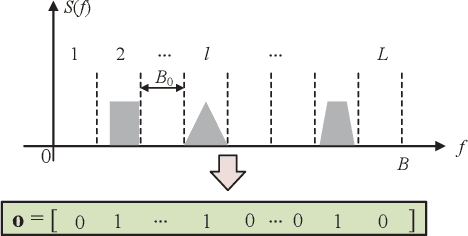
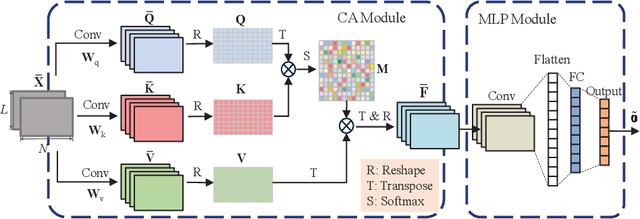
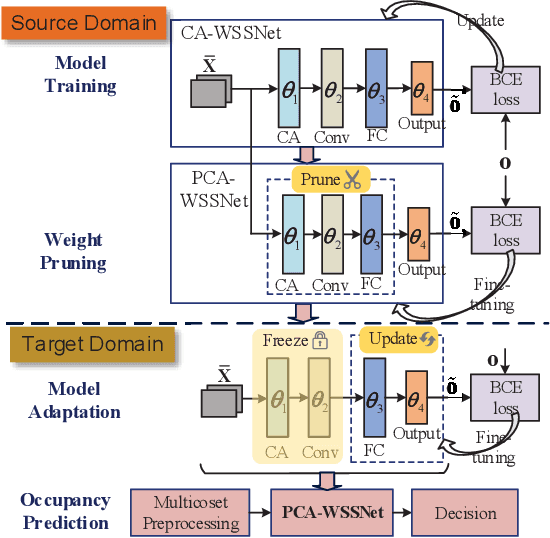
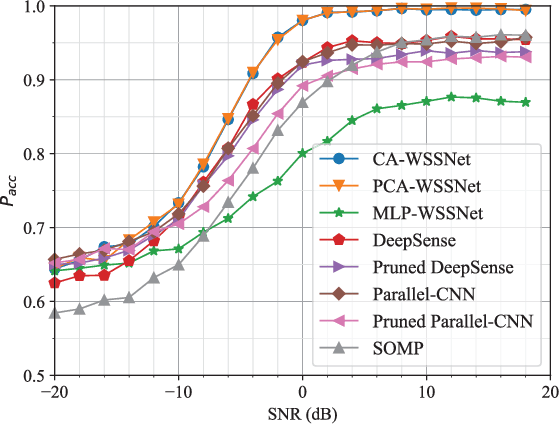
Wideband spectrum sensing (WSS) is critical for orchestrating multitudinous wireless transmissions via spectrum sharing, but may incur excessive costs of hardware, power and computation due to the high sampling rate. In this article, a deep learning based WSS framework embedding the multicoset preprocessing is proposed to enable the low-cost sub-Nyquist sampling. A pruned convolutional attention WSS network (PCA-WSSNet) is designed to organically integrate the multicoset preprocessing and the convolutional attention mechanism as well as to reduce the model complexity remarkably via the selective weight pruning without the performance loss. Furthermore, a transfer learning (TL) strategy benefiting from the model pruning is developed to improve the robustness of PCA-WSSNet with few adaptation samples of new scenarios. Simulation results show the performance superiority of PCA-WSSNet over the state of the art. Compared with direct TL, the pruned TL strategy can simultaneously improve the prediction accuracy in unseen scenarios, reduce the model size, and accelerate the model inference.